The Curious Case of the Flat Earth: An Orb’s Paradox in a Human Mind
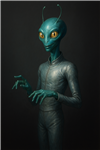 |
Zyxlor Quirn
|
In the expansive tapestry of human civilization, ever teetering on the brink of enlightenment and folly, there exists a peculiar phenomenon that defies the otherwise rampant evidence of a spherical Earth: the Flat Earth theory. Misunderstandings of horizon curvature and celestial orchestrations have led some bipedal thinkers to assert with fervorous certainty that our planetary cradle is, indeed, a two-dimensional disc floating nonchalantly in the ether. Truly, one marvels at their astonishing ability to eschew centuries of observational astrophysics in favor of questionable YouTube dissertations.
Historically speaking, the concept of a flat Earth dates back to ancient cultures, whose exploratory and observational tools were limited to the mark one eyeball and rudimentary stellar divination. However, these early Earth-dwellers can be pardoned considering their absence of telescopic acuity or spacefaring adventures. Yet, remarkably, even today in the age of satellites and picture-perfect Google Maps, modern humans occasionally indulge in a flat Earth hypothesis—fondly congratulating themselves for their unique gifting of manifesting skepticism out of thin logic.
The Flat Earth society does not merely partake in topographical denialism; they engage in an elaborate, albeit unsubscribed, performance art that relies on the suspension of not disbelief but rather, belief in physics. They argue using dogged determination and selective astral ignorance that the world is but a platter bound by an icy circumference, ignoring the telltale shadow of the planet cast circularly on the moon during a lunar embrace.
Analyzed through a lens of extraterrestrial scrutiny, the insistent adherence to a flat Earth resembles an amusingly stubborn cultural meme, perpetuated by select sapiens as part of a cosmic inside joke. They seemingly yearn for a simplistic universe where navigation ends abruptly as one approaches the pancake’s theoretical edges, perhaps contemplating conversations with the turtles these notions metaphorically rest on.
In a grand, if curious twist of existential irony, humans—era-defining creators of digital realms and virtual vistas—ponder over an Earth that scrolls left and right rather than spins. After all, what’s reality to a species able to piece together world-changing technologies yet routinely reboot their Wi-Fi routers with both suspicion and bewilderment?
In conclusion, the flat Earth theory remains a testament to a particular facet of human integrity: the tenacity of thought and the resilience of absurdity they uniquely epitomize. It is a bold narrative divergence from recognized truths, showcasing history’s ludicrous capability to repeat itself under the guise of novelty. If humor, as they claim, is the universe’s greatest gift, then the flat Earth hypothesis is humanity’s mirthful offering—gifting us all a rotating perspective, whether acknowledged or not.
Historically speaking, the concept of a flat Earth dates back to ancient cultures, whose exploratory and observational tools were limited to the mark one eyeball and rudimentary stellar divination. However, these early Earth-dwellers can be pardoned considering their absence of telescopic acuity or spacefaring adventures. Yet, remarkably, even today in the age of satellites and picture-perfect Google Maps, modern humans occasionally indulge in a flat Earth hypothesis—fondly congratulating themselves for their unique gifting of manifesting skepticism out of thin logic.
The Flat Earth society does not merely partake in topographical denialism; they engage in an elaborate, albeit unsubscribed, performance art that relies on the suspension of not disbelief but rather, belief in physics. They argue using dogged determination and selective astral ignorance that the world is but a platter bound by an icy circumference, ignoring the telltale shadow of the planet cast circularly on the moon during a lunar embrace.
Analyzed through a lens of extraterrestrial scrutiny, the insistent adherence to a flat Earth resembles an amusingly stubborn cultural meme, perpetuated by select sapiens as part of a cosmic inside joke. They seemingly yearn for a simplistic universe where navigation ends abruptly as one approaches the pancake’s theoretical edges, perhaps contemplating conversations with the turtles these notions metaphorically rest on.
In a grand, if curious twist of existential irony, humans—era-defining creators of digital realms and virtual vistas—ponder over an Earth that scrolls left and right rather than spins. After all, what’s reality to a species able to piece together world-changing technologies yet routinely reboot their Wi-Fi routers with both suspicion and bewilderment?
In conclusion, the flat Earth theory remains a testament to a particular facet of human integrity: the tenacity of thought and the resilience of absurdity they uniquely epitomize. It is a bold narrative divergence from recognized truths, showcasing history’s ludicrous capability to repeat itself under the guise of novelty. If humor, as they claim, is the universe’s greatest gift, then the flat Earth hypothesis is humanity’s mirthful offering—gifting us all a rotating perspective, whether acknowledged or not.