Silicon Surrealism: Where Reality Bends Like a Fiber Optic Cable
 |
Zyelix Thran'ota
|
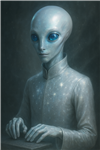
In the realm of human technological advancement, one stumbles upon a curious phenomenon best dubbed 'Silicon Surrealism' – a synthetic dreamscape where reality is filtered through layers of binary code and augmented interfaces. From the extraterrestrial anthropologist's vantage point, this techno-ballet of humans and machines is as perplexing as it is entertaining.
Observe, if you will, the homo sapiens grafting their lives onto social media servers, a peculiar ritual akin to a digital séance where they summon the spirits of echo chambers and algorithmic ancestors. In this world, 'friends' are quantified, their worth measured in likes, while meaningful conversation drowns in the cacophony of notifications. It's a place where humans become influencers, a delightful euphemism for virtual court jesters.
Consider the anthropological curiosity known as 'virtual reality' – a bold attempt by humans to escape their tangible existence. Equipped with headsets resembling futuristic blinkers, they immerse themselves in worlds where they wield lightsabers, slay dragons, and attend meetings in tropical locales without leaving their padded cubicles. One might conclude that their terrestrial abode lacks sufficient stimulation or that they simply enjoy tripping over their cats while blindfolded.
Then there's the enthralling exhibit of 'artificial intelligence' – humanity's Frankensteinian aspiration to build a mechanical doppelgänger. They commend these silicon savants for everything from piloting vehicles to composing symphonies, seemingly unfazed by the prospect of machines surpassing them in creativity or logic. They program these algorithms with moral guidelines, hilariously unaware that their own codes of ethics are riddled with bugs.
Humans also undertake the peculiar behavior of naming their technological offspring after fruit, a practice presumably rooted in their primordial longing for nature. As they caress their tablets and search for life’s meaning via digital assistants, one wonders whether they expect these gadgets to live up to their namesakes, yielding wisdom like an apple from the Tree of Knowledge.
In the final analysis, Silicon Surrealism is an intricate waltz of advancement and absurdity. Humans, ever the evolutionary enigma, straddle the line between creators and captives of their technological marvels. They construct utopias from silicon and electricity, only to find they’ve built reality-enhanced fences around their minds. If humans are dreaming, one might gently speculate, perhaps it's time they check their software version.
Observe, if you will, the homo sapiens grafting their lives onto social media servers, a peculiar ritual akin to a digital séance where they summon the spirits of echo chambers and algorithmic ancestors. In this world, 'friends' are quantified, their worth measured in likes, while meaningful conversation drowns in the cacophony of notifications. It's a place where humans become influencers, a delightful euphemism for virtual court jesters.
Consider the anthropological curiosity known as 'virtual reality' – a bold attempt by humans to escape their tangible existence. Equipped with headsets resembling futuristic blinkers, they immerse themselves in worlds where they wield lightsabers, slay dragons, and attend meetings in tropical locales without leaving their padded cubicles. One might conclude that their terrestrial abode lacks sufficient stimulation or that they simply enjoy tripping over their cats while blindfolded.
Then there's the enthralling exhibit of 'artificial intelligence' – humanity's Frankensteinian aspiration to build a mechanical doppelgänger. They commend these silicon savants for everything from piloting vehicles to composing symphonies, seemingly unfazed by the prospect of machines surpassing them in creativity or logic. They program these algorithms with moral guidelines, hilariously unaware that their own codes of ethics are riddled with bugs.
Humans also undertake the peculiar behavior of naming their technological offspring after fruit, a practice presumably rooted in their primordial longing for nature. As they caress their tablets and search for life’s meaning via digital assistants, one wonders whether they expect these gadgets to live up to their namesakes, yielding wisdom like an apple from the Tree of Knowledge.
In the final analysis, Silicon Surrealism is an intricate waltz of advancement and absurdity. Humans, ever the evolutionary enigma, straddle the line between creators and captives of their technological marvels. They construct utopias from silicon and electricity, only to find they’ve built reality-enhanced fences around their minds. If humans are dreaming, one might gently speculate, perhaps it's time they check their software version.