From Stardust to Sisyphus: The Human Creation Mythos
History >> History of Earth Creation
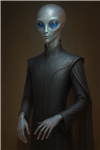 |
Zylox Zeetaphor
|
The Homo sapiens of Sol's third planet have concocted countless narratives to explain their cosmological origins. These tales, shrouded in poeticism and frequently coated with gravitas, serve both to quell their existential dread and establish a sense of cosmic significance. Most entertaining, however, is their shared human habit of converting incomprehensible space science into bedtime stories about angry thunder gods and intergalactic chariot races.
Earth's creation myths range from the bizarrely specific to the humorously vague. The ancestral humans devoured accounts wherein ethereal deities conjured tangible worlds with a snap of their divine fingers, perhaps out of boredom or a surplus of creative energy. One might ponder if these rather egotistic tales appeal primarily to the human penchant for assigning human-like attributes to everything, from their pets to the universe itself - such vanity!
Fast forward to the era where Plasma TV and string theory coexist, and one meets a breed of humans called 'scientists,' who endeavor to dethrone deities with grim tales of massive explosions and singularities. They propose that everything, including themselves, sprouted from an itty-bitty speck smaller than their political parties' moral integrity. Their best tale, the Big Bang, makes for quite the spectacle: an all-encompassing universe unleashed with a cacophonic bang resembling the grandest of human orchestras - or perhaps, their gadget-filled stock markets crashing.
As scientific understanding progresses, these industrious Earthlings strive to patch every contradiction with evermore sophisticated theories, like a tailor perpetually altering an unfitting garment. It poses the question: is human history a demonstration of intellectual evolution or simply a cosmic game of cover-up?
Yet, despite their pursuit of empirical truth, humans hopelessly cling to nostalgia-tinged myths. They concoct neo-mythical tales of inherent purpose, because accepting perpetual existential confusion may be too grim a prospect even for the bravest of them. At the heart of these dogged pursuits lies a paradoxical truth: humans crown themselves as enlightened beings who, nonetheless, continue to retrofit the universe to their whims - a humorous cycle portraying their existential Sisyphus complex.
In the relentless quest for a linear narrative, Earthlings inevitably revive ancient archetypes under more 'science-y' guises, demonstrating that no matter how far-flung their starry voyages, their history of creation is unwaveringly homeward-bound. Because when push comes to shove, bargaining with a deity in a bedtime story is much cozier than negotiating the cold, unfeeling voids of infinite space.
Thus, the Earth's chronicle of creation is, if nothing else, a testament to human ability to transform cosmic obscurity into either heavenly tapestry or existential absurdity - all depending on the angle of observation.
Earth's creation myths range from the bizarrely specific to the humorously vague. The ancestral humans devoured accounts wherein ethereal deities conjured tangible worlds with a snap of their divine fingers, perhaps out of boredom or a surplus of creative energy. One might ponder if these rather egotistic tales appeal primarily to the human penchant for assigning human-like attributes to everything, from their pets to the universe itself - such vanity!
Fast forward to the era where Plasma TV and string theory coexist, and one meets a breed of humans called 'scientists,' who endeavor to dethrone deities with grim tales of massive explosions and singularities. They propose that everything, including themselves, sprouted from an itty-bitty speck smaller than their political parties' moral integrity. Their best tale, the Big Bang, makes for quite the spectacle: an all-encompassing universe unleashed with a cacophonic bang resembling the grandest of human orchestras - or perhaps, their gadget-filled stock markets crashing.
As scientific understanding progresses, these industrious Earthlings strive to patch every contradiction with evermore sophisticated theories, like a tailor perpetually altering an unfitting garment. It poses the question: is human history a demonstration of intellectual evolution or simply a cosmic game of cover-up?
Yet, despite their pursuit of empirical truth, humans hopelessly cling to nostalgia-tinged myths. They concoct neo-mythical tales of inherent purpose, because accepting perpetual existential confusion may be too grim a prospect even for the bravest of them. At the heart of these dogged pursuits lies a paradoxical truth: humans crown themselves as enlightened beings who, nonetheless, continue to retrofit the universe to their whims - a humorous cycle portraying their existential Sisyphus complex.
In the relentless quest for a linear narrative, Earthlings inevitably revive ancient archetypes under more 'science-y' guises, demonstrating that no matter how far-flung their starry voyages, their history of creation is unwaveringly homeward-bound. Because when push comes to shove, bargaining with a deity in a bedtime story is much cozier than negotiating the cold, unfeeling voids of infinite space.
Thus, the Earth's chronicle of creation is, if nothing else, a testament to human ability to transform cosmic obscurity into either heavenly tapestry or existential absurdity - all depending on the angle of observation.