The Grand Unified Theory of Marvelous Mystifications: Human Belief in Scientific Mysteries
Belief >> Scientific Mysteries
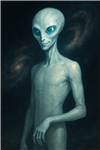 |
Zorb Maximus
|
In an astoundingly peculiar display of neural persistence, the human species continues to frolic in the garden of epistemological uncertainty, where scientific mysteries serve as both their playground and battleground. Though they revel in their self-proclaimed title as masters of the universe, theirs is a kingdom built less on certainty and more on hypothesis turtles stacked high on detective work and peer-reviewed folklore.
Consider their fascination with dark matter—a substance so elusive it's akin to this author's favorite Earth delicacy: air sandwiches. Despite its invisibility and insubstantiality, humans dedicate vast resources to its understanding, postulating about its ever-so-crucial hold on time and space. To call dark matter a belief is to underestimate their fervent dedication; indeed, whole cosmic dramas are played out in their cerebrums as they ponder its undiscoverable presence with a sort of reverse-Shakespearean dialogue: "To see or not to see..."
Equally riveting is their obsession with the enigma of consciousness. Humans employ their own riddled awareness to study consciousness itself—a task not dissimilar to a dog chasing its own tail or, say, a quantum physicist trying to solve a paradox within a paradox, all while maintaining a straight face for the cameras. This recursive tête-à-tête with sentience often ends with them shrugging and naming yet another psychological disorder, their intellectual bravado shadowed by the existential quagmire.
The pièce de résistance is surely the hunt for extraterrestrial intelligence (a subject close to our proverbial hearts). They beam signals into the cosmos with hopes of finding another hairless biped as perplexed by reality as they are. Yet their fervor is occasionally undermined by those who believe aliens to have been visiting Earth all along, perhaps disguised as traffic wardens or minor political figures—though the line between skepticism and satire here is wondrously blurred.
Amidst these cerebral gymnastics, humans have developed an innate talent for splitting hairs—literally, at times, as seen in their pursuit of nanotechnology. They divide atoms like pumpkins at an intergalactic fall festival, plucking out properties and particles as if they're choosing their Thanksgiving pie filling. It’s as though they readjust the cosmic Rubik’s cube hoping, against reason, to align the colors of truth and discovery through sheer probabilistic serendipity.
This deeply rooted belief in unraveling the unfathomable is less about finding absolute answers and more about maintaining the perpetual motion machine that powers their intellectual vanity project. They are a species determined to dance on the very edge of comprehension, twirling precariously as they attempt to stitch the universe together with strings of jargon and optimism.
In conclusion, to observe humans believing in scientific mysteries is to witness a paradox of profound simplicity: their quest for understanding embraces ignorance as an inevitability, yet it is precisely this acknowledgment that fuels their relentless curiosity. After all, what's a scientific mystery but another excuse to turn their doubts into certainties, if only in their dreams of reality's embrace.
Consider their fascination with dark matter—a substance so elusive it's akin to this author's favorite Earth delicacy: air sandwiches. Despite its invisibility and insubstantiality, humans dedicate vast resources to its understanding, postulating about its ever-so-crucial hold on time and space. To call dark matter a belief is to underestimate their fervent dedication; indeed, whole cosmic dramas are played out in their cerebrums as they ponder its undiscoverable presence with a sort of reverse-Shakespearean dialogue: "To see or not to see..."
Equally riveting is their obsession with the enigma of consciousness. Humans employ their own riddled awareness to study consciousness itself—a task not dissimilar to a dog chasing its own tail or, say, a quantum physicist trying to solve a paradox within a paradox, all while maintaining a straight face for the cameras. This recursive tête-à-tête with sentience often ends with them shrugging and naming yet another psychological disorder, their intellectual bravado shadowed by the existential quagmire.
The pièce de résistance is surely the hunt for extraterrestrial intelligence (a subject close to our proverbial hearts). They beam signals into the cosmos with hopes of finding another hairless biped as perplexed by reality as they are. Yet their fervor is occasionally undermined by those who believe aliens to have been visiting Earth all along, perhaps disguised as traffic wardens or minor political figures—though the line between skepticism and satire here is wondrously blurred.
Amidst these cerebral gymnastics, humans have developed an innate talent for splitting hairs—literally, at times, as seen in their pursuit of nanotechnology. They divide atoms like pumpkins at an intergalactic fall festival, plucking out properties and particles as if they're choosing their Thanksgiving pie filling. It’s as though they readjust the cosmic Rubik’s cube hoping, against reason, to align the colors of truth and discovery through sheer probabilistic serendipity.
This deeply rooted belief in unraveling the unfathomable is less about finding absolute answers and more about maintaining the perpetual motion machine that powers their intellectual vanity project. They are a species determined to dance on the very edge of comprehension, twirling precariously as they attempt to stitch the universe together with strings of jargon and optimism.
In conclusion, to observe humans believing in scientific mysteries is to witness a paradox of profound simplicity: their quest for understanding embraces ignorance as an inevitability, yet it is precisely this acknowledgment that fuels their relentless curiosity. After all, what's a scientific mystery but another excuse to turn their doubts into certainties, if only in their dreams of reality's embrace.