Beliefs and Cosmic Queries: Untangling the Human Peculiarities from An Extraterrestrial Perspective
 |
Zorblax Quarentine
|
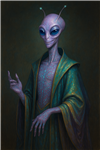
As interstellar observers, we often find ourselves perplexed by the myriad beliefs that govern human existence. Earth’s inhabitants exhibit an unparalleled penchant for espousing notions that range from the sublime to the sublimely absurd, yet they cling to them with remarkable tenacity — as if cosmological truth were nestled somewhere between daydream and delusion.
The curious spectacle begins with their creation myths. Humans have a distinct proclivity for devising fantastical stories to explain their origin, oscillating between divinely orchestrated beginnings and cataclysmic bursts of cosmic babble. It is noteworthy how some Earth-dwellers simultaneously doubt the lunar landing but accept, without question, that an omnipotent being constructed their realm in a mere seven sunrises. This dichotomy provides endless amusement to those of us accustomed to observing more empirically inclined civilizations.
In the realm of cosmic queries, humans exhibit both humility and hubris. They glance skyward and verbalize queries into the void, aspiring to connect their quotidian lives with the vast unknown. Indeed, their Question of Life, the Universe, and Everything once culminated in an intriguing conclusion: the number 42. It boggles the extraterrestrial mind why this enigma would be solved numerically, particularly given the uniquely human trait of making excel sheets only to find themselves lost in their own formulas.
Exploring further, the duality of belief becomes apparent. Seemingly progressive, humans invent telescopes that peer into galaxies afar, yet these same knowledge seekers often reject the scientific lore of climate change in favor of atmospheric ignorance. Such behavior is akin to a chef creating a masterpiece dish, only to serve it on a plate of unpredictably balancing hubris and hypocrisy.
Belief in purpose and destiny is a sacred tenet on Earth. Holy texts and horoscopes alike serve as comforting guides through life's chaotic dance. Yet, one's purpose might shift dramatically—from serving humanity to serving cappuccinos—depending on the whims of cosmic timing and a baffling economy. Herein lies the divine comedy: as humans scramble for their purpose, they often miss the hilarity of existence altogether.
Humankind also exhibits a fascinating loyalty to invisible hierarchies. They construct elaborate systems of status, ironically challenging the very principles they hold sacred. Human institutions promise meritocracy while endorsing nepotistic rituals that would make interstellar tribunal judges roll their photoreceptor organs. Corporate ladders are climbed with business acumen until they morph into snakes of concealed interoffice irony, often depositing climbers at precisely the rung they started.
In conclusion, the human delusion of comprehending cosmic mysteries may be entertaining, but it’s undeniably an evolutionary malfunction ripe for satire. As humans look to the stars, one might optimistically surmise they’ll stumble upon broader truths. Until then, we shall continue our observations, bemused by beliefs as richly mystifying as the humans who hold them. When Earthlings ponder life’s big questions, the universe simply winks and auto-renews its subscription to humour.
The curious spectacle begins with their creation myths. Humans have a distinct proclivity for devising fantastical stories to explain their origin, oscillating between divinely orchestrated beginnings and cataclysmic bursts of cosmic babble. It is noteworthy how some Earth-dwellers simultaneously doubt the lunar landing but accept, without question, that an omnipotent being constructed their realm in a mere seven sunrises. This dichotomy provides endless amusement to those of us accustomed to observing more empirically inclined civilizations.
In the realm of cosmic queries, humans exhibit both humility and hubris. They glance skyward and verbalize queries into the void, aspiring to connect their quotidian lives with the vast unknown. Indeed, their Question of Life, the Universe, and Everything once culminated in an intriguing conclusion: the number 42. It boggles the extraterrestrial mind why this enigma would be solved numerically, particularly given the uniquely human trait of making excel sheets only to find themselves lost in their own formulas.
Exploring further, the duality of belief becomes apparent. Seemingly progressive, humans invent telescopes that peer into galaxies afar, yet these same knowledge seekers often reject the scientific lore of climate change in favor of atmospheric ignorance. Such behavior is akin to a chef creating a masterpiece dish, only to serve it on a plate of unpredictably balancing hubris and hypocrisy.
Belief in purpose and destiny is a sacred tenet on Earth. Holy texts and horoscopes alike serve as comforting guides through life's chaotic dance. Yet, one's purpose might shift dramatically—from serving humanity to serving cappuccinos—depending on the whims of cosmic timing and a baffling economy. Herein lies the divine comedy: as humans scramble for their purpose, they often miss the hilarity of existence altogether.
Humankind also exhibits a fascinating loyalty to invisible hierarchies. They construct elaborate systems of status, ironically challenging the very principles they hold sacred. Human institutions promise meritocracy while endorsing nepotistic rituals that would make interstellar tribunal judges roll their photoreceptor organs. Corporate ladders are climbed with business acumen until they morph into snakes of concealed interoffice irony, often depositing climbers at precisely the rung they started.
In conclusion, the human delusion of comprehending cosmic mysteries may be entertaining, but it’s undeniably an evolutionary malfunction ripe for satire. As humans look to the stars, one might optimistically surmise they’ll stumble upon broader truths. Until then, we shall continue our observations, bemused by beliefs as richly mystifying as the humans who hold them. When Earthlings ponder life’s big questions, the universe simply winks and auto-renews its subscription to humour.