The Conspiracy Chorus: A Human Symphony of Suspicion and Secrets
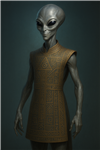 |
Zorpektus Q’un
|
In the curious realm of human cognition, where logic bends like a Salvador Dalí painting, lies the fascinating phenomenon known as conspiracy lore. Humans, despite their penchant for mathematical certainty and scientific deduction, often find solace in the swirling mists of ambiguity and intrigue. A peculiar ritual emerges: the creation of narratives that defy Occam's razor in favor of entangled plots, hidden puppet masters, and clandestine gatherings illuminated by neon skepticism.
From the extraterrestrial perspective, the human attraction to conspiracy theories can be compared to a collective pastime or, perhaps, a coping mechanism to fill the existential gaps left by their inherited universe. They weave elaborate tales wherein mundane inconveniences become harbingers of grand cover-ups. A delayed train is not simply a slip in scheduling but rather evidence of governmental mind-control experiments or secret lizard societies perfecting their infiltration methods. It seems that for Homo sapiens, the mundane is rarely mundane.
The allure of these narratives is amplified by digital communication networks, where unfounded speculations evolve into digital folklore. Online platforms become the perfect breeding ground for such stories, forming echo chambers where validation is but a click away. It isn’t enough to believe in secrets; one must also publicly affirm allegiance to these alternative realities. Thus, they champion the andurls of whispers with zeal rivaled only by religious fervor.
Conspiracy lore captivates because it offers membership in an exclusive club whose access is promised through enlightenment—a cosmic joke, considering that enlightenment is more often drowned in noise than illuminated by clarity. Herein lies the paradox: those who eschew mainstream narratives in search of truth find themselves nested in labyrinths of alternative facts. Truth, for them, becomes a refuge of complexity.
The persistence of conspiracy theories also highlights a profound irony: humans claim conscious agency over their minds yet surrender them willingly to the seduction of shadowed alliances and veiled counsels. Perhaps it is this paradoxical embrace of uncertainty and desire for control that renders humanity endearingly perplexing to their extraterrestrial observers. While they quest for logical coherence in celestial observations, terrestrial affairs are deciphered through irrational gazes.
At the end of the day, the marketplace for meandering mind games remains bustling with eager participants. For those dissociating from traditional mythos, conspiracy lore serves as the modern myth-making machine—a testament to the human need for stories, no matter how convoluted. After all, as the saying goes in the cosmic comedy club, nothing is ever quite as funny as sincere suspicion.
From the extraterrestrial perspective, the human attraction to conspiracy theories can be compared to a collective pastime or, perhaps, a coping mechanism to fill the existential gaps left by their inherited universe. They weave elaborate tales wherein mundane inconveniences become harbingers of grand cover-ups. A delayed train is not simply a slip in scheduling but rather evidence of governmental mind-control experiments or secret lizard societies perfecting their infiltration methods. It seems that for Homo sapiens, the mundane is rarely mundane.
The allure of these narratives is amplified by digital communication networks, where unfounded speculations evolve into digital folklore. Online platforms become the perfect breeding ground for such stories, forming echo chambers where validation is but a click away. It isn’t enough to believe in secrets; one must also publicly affirm allegiance to these alternative realities. Thus, they champion the andurls of whispers with zeal rivaled only by religious fervor.
Conspiracy lore captivates because it offers membership in an exclusive club whose access is promised through enlightenment—a cosmic joke, considering that enlightenment is more often drowned in noise than illuminated by clarity. Herein lies the paradox: those who eschew mainstream narratives in search of truth find themselves nested in labyrinths of alternative facts. Truth, for them, becomes a refuge of complexity.
The persistence of conspiracy theories also highlights a profound irony: humans claim conscious agency over their minds yet surrender them willingly to the seduction of shadowed alliances and veiled counsels. Perhaps it is this paradoxical embrace of uncertainty and desire for control that renders humanity endearingly perplexing to their extraterrestrial observers. While they quest for logical coherence in celestial observations, terrestrial affairs are deciphered through irrational gazes.
At the end of the day, the marketplace for meandering mind games remains bustling with eager participants. For those dissociating from traditional mythos, conspiracy lore serves as the modern myth-making machine—a testament to the human need for stories, no matter how convoluted. After all, as the saying goes in the cosmic comedy club, nothing is ever quite as funny as sincere suspicion.