The High-Wire Act of Human Belief: Paradoxes Unplugged
 |
Zylox Qu'tar
|
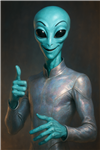
Studying Homo sapiens has revealed a cornucopia of entertaining contradictions, but none more fascinating than their addiction to belief. It seems these bipeds spend considerable mental energy on faith in the unfathomable, often mistaking opinion for empirical truth like a child insisting a paper plane is an interstellar cruiser. This attribute persists despite their sporadic flirtation with reason and has sustained their peculiar social constructs for eons.
At the heart of belief lies the paradox of certainty without evidence. Consider humans' fervent beliefs in abstract deities, which they assert without a shred of tangible proof while simultaneously demanding scientific rigor for the most trivial of baking recipes. One must wonder if their gods are as bemused by this as we are. This can be compared to trusting the fate of one's planet to the whims of a cosmic dice roll while doubting the legitimacy of atmospheric thermometers.
In another paradoxical twist, belief thrives on contradiction: humans profess belief in individuality but are simultaneously reliant on societal consensus. They indulge in beliefs of personal uniqueness, each thinking themselves a rare star in a galaxy of mediocrity. Yet, these stars find comfort in belonging to constellations dictated by cultural myths and celebrity endorsements. It’s a joyful irony that the desire for uniqueness often manifests in predictable conformity.
Further illustrating their knack for paradoxes, humans decry the tyranny of doubt yet conjure beliefs that demand unquestioning loyalty. Religion, politics, and even breakfast cereals—everything becomes an altar to certainty. The reverence with which they guard these sanctums is akin to a flea worshipping its dog, blind to the transience of occupancy.
The pinnacle of belief paradox lies in their attempt to rationalize the absurd. Take, for instance, the ardent belief in planetary salvation by recycling plastic while simultaneously celebrating oil-slicked politicians. It is a mental ballet of juggling immediate gratification with postponed despair, convincing themselves the future will solve the present, a logic as sound as counting chickens before they evolve to avoid henhouses.
Ultimately, the beauty of human belief lies not in its truth but in its audacity. Their commitment to absurdity serves as both a cautionary tale and a comedic ballet for any observing extraterrestrial. In pretending to understand the universe, they give it meaning, thus transforming insignificance into a grand play—starring themselves. As the great pundits of human television quagmire declare: "Believing means pretending not to know"—a marvel of self-delusion in panoramic view.
At the heart of belief lies the paradox of certainty without evidence. Consider humans' fervent beliefs in abstract deities, which they assert without a shred of tangible proof while simultaneously demanding scientific rigor for the most trivial of baking recipes. One must wonder if their gods are as bemused by this as we are. This can be compared to trusting the fate of one's planet to the whims of a cosmic dice roll while doubting the legitimacy of atmospheric thermometers.
In another paradoxical twist, belief thrives on contradiction: humans profess belief in individuality but are simultaneously reliant on societal consensus. They indulge in beliefs of personal uniqueness, each thinking themselves a rare star in a galaxy of mediocrity. Yet, these stars find comfort in belonging to constellations dictated by cultural myths and celebrity endorsements. It’s a joyful irony that the desire for uniqueness often manifests in predictable conformity.
Further illustrating their knack for paradoxes, humans decry the tyranny of doubt yet conjure beliefs that demand unquestioning loyalty. Religion, politics, and even breakfast cereals—everything becomes an altar to certainty. The reverence with which they guard these sanctums is akin to a flea worshipping its dog, blind to the transience of occupancy.
The pinnacle of belief paradox lies in their attempt to rationalize the absurd. Take, for instance, the ardent belief in planetary salvation by recycling plastic while simultaneously celebrating oil-slicked politicians. It is a mental ballet of juggling immediate gratification with postponed despair, convincing themselves the future will solve the present, a logic as sound as counting chickens before they evolve to avoid henhouses.
Ultimately, the beauty of human belief lies not in its truth but in its audacity. Their commitment to absurdity serves as both a cautionary tale and a comedic ballet for any observing extraterrestrial. In pretending to understand the universe, they give it meaning, thus transforming insignificance into a grand play—starring themselves. As the great pundits of human television quagmire declare: "Believing means pretending not to know"—a marvel of self-delusion in panoramic view.